Public adjuster statistics: what official data shows
Figures from regulators, a state legislature's research office and a state-run insurer. No numbers from adjuster firms, law firms or trade groups.
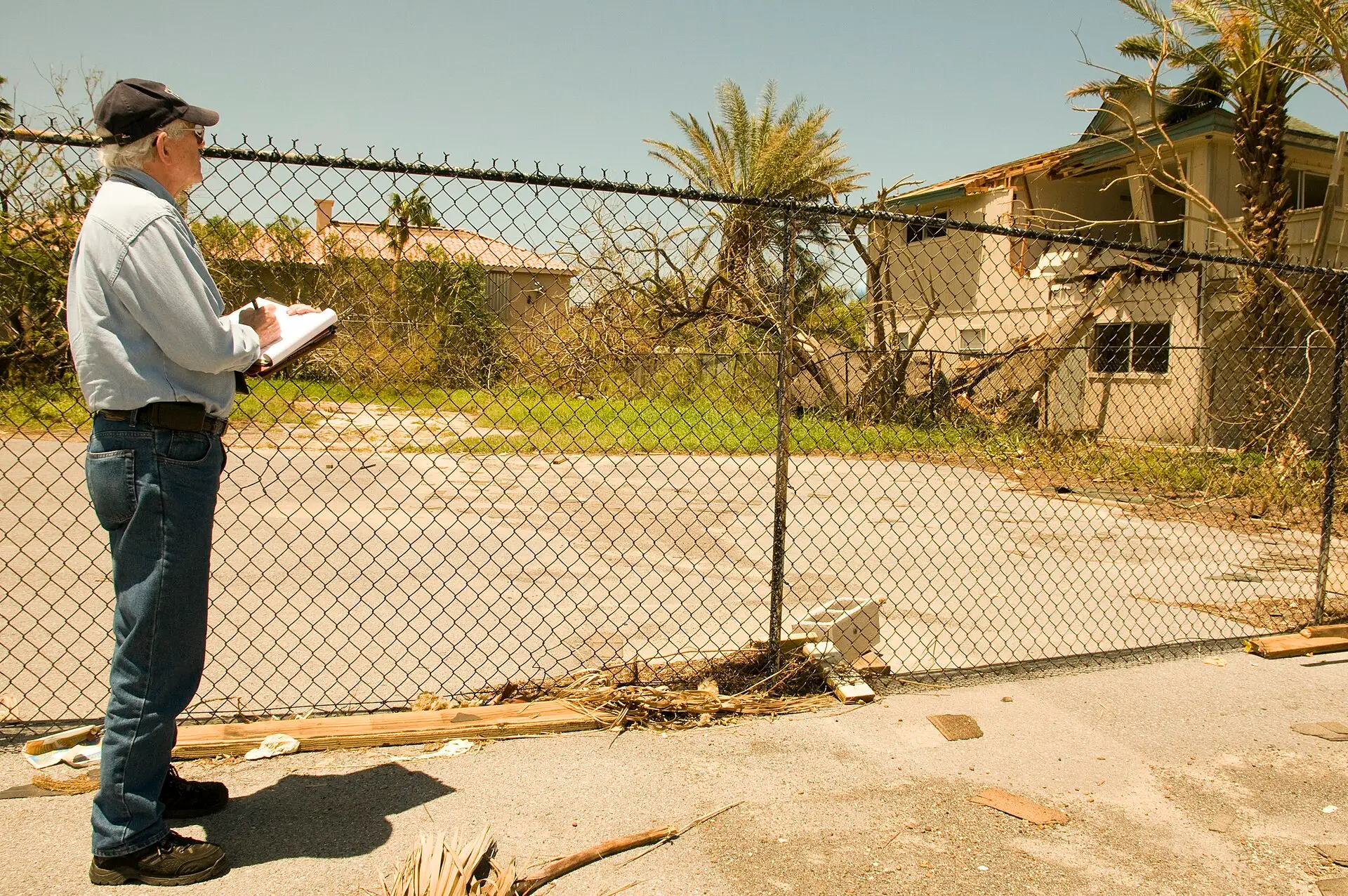
Photo: a FEMA specialist inspecting a damaged home, South Padre Island, Texas, July 2008. Patsy Lynch / FEMA, public domain. Use does not imply endorsement.

Official data on public adjusters is thin. One government study, from Florida in 2010, compares claims with and without a public adjuster. It found higher payments and longer timelines when one was involved.
Newer figures show how often public adjusters appear in claims and lawsuits, mostly in Florida. They do not show whether hiring one changes the result. Nobody has published a comparison since.
estimated payment on a non-catastrophe claim with a public adjuster, against $1,391 without. One Florida insurer, 2008 to 2009, before fees.
median time to close that kind of claim with a public adjuster, against 41 days without
of that insurer's non-catastrophe claims involved a public adjuster in the study period
of new residential lawsuits against the same insurer in 2025 had a public adjuster on the claim from first notice
valid individual public adjuster licences in Florida, November 10, 2026
public insurance adjuster licences in Texas, fiscal year 2025
Do claims with a public adjuster pay more?
The one official comparison comes from the Florida Legislature's research office, OPPAGA. It looked at claims filed with Citizens Property Insurance, the state-run insurer, between March 2008 and June 2009.
Claims with a public adjuster received larger payments, by a wide margin on everyday claims and a smaller one on 2004 hurricane claims.
Four limits to keep in mind.
- The payments are before the public adjuster's fee.
- The study did not show that the two groups of claims were alike. People may hire help for the harder claims.
- It covers one insurer in one state, and the claims are more than 15 years old.
- No official study has repeated it since.
- Everyday claim with $9,379
- Everyday claim without $1,391
- 2004 hurricane with $22,266
- 2004 hurricane without $18,659
Every figure from the Florida study
-
26%
Share of non-catastrophe claims filed with Citizens in which the policyholder was represented by a public adjuster (24% of new claims, 54% of re-opened claims). · Claims filed March 2008 to June 2009
Read with care: Citizens Property Insurance Corporation only (Florida's state-run insurer), claims filed March 2008 to June 2009. The 'no public adjuster' group includes claims handled by attorneys. Data is more than 15 years old.
Florida Legislature, Office of Program Policy Analysis and Government Accountability (OPPAGA), Page 6 (show the source wording)
The source says“policyholders represented by a public adjuster submitted slightly over a quarter (26%) of non-catastrophe claims filed in 2008 and 2009, including 24% of new and 54% of re-opened non-catastrophe claims.”
Read it at the source (opens in a new tab) -
39%
Share of catastrophe claims (tied to the 2004 and 2005 hurricanes) filed with Citizens in which the policyholder was represented by a public adjuster (19% of new claims, 57% of re-opened claims). · Claims filed March 2008 to June 2009
Read with care: Citizens Property Insurance Corporation only (Florida's state-run insurer), claims filed March 2008 to June 2009. The 'no public adjuster' group includes claims handled by attorneys. Data is more than 15 years old. More than half of the catastrophe claims studied were re-opened claims from storms three to five years earlier.
Florida Legislature, Office of Program Policy Analysis and Government Accountability (OPPAGA), Page 6 (show the source wording)
The source says“policyholders represented by a public adjuster filed 39% of catastrophe claims, including 19% of new and 57% of re-opened catastrophe claims.”
Read it at the source (opens in a new tab) -
21,545 of 76,321
Number of Citizens claims in the OPPAGA study that had public adjuster representation, out of all claims studied. · Claims filed March 2008 to June 2009
Read with care: Citizens Property Insurance Corporation only (Florida's state-run insurer), claims filed March 2008 to June 2009. The 'no public adjuster' group includes claims handled by attorneys. Data is more than 15 years old.
Florida Legislature, Office of Program Policy Analysis and Government Accountability (OPPAGA), Page 9, Appendix A (show the source wording)
The source says“We evaluated all claims filed with Citizens from March 2008 to June 2009, for a total of 76,321 claims. Of this population, 21,545 had public adjuster representation.”
Read it at the source (opens in a new tab) -
$9,379 vs $1,391
Estimated payment on non-catastrophe Citizens claims with a public adjuster ($9,379) compared with claims without one ($1,391), a 574% difference. · Claims filed March 2008 to June 2009
Read with care: Citizens Property Insurance Corporation only (Florida's state-run insurer), claims filed March 2008 to June 2009. The 'no public adjuster' group includes claims handled by attorneys. Data is more than 15 years old. Payments are before the public adjuster's fee. The report compares medians and does not show the two groups of claims were otherwise alike, so the gap is not proof of what a public adjuster adds.
Florida Legislature, Office of Program Policy Analysis and Government Accountability (OPPAGA), Page 8 (show the source wording)
The source says“policyholders who used public adjusters received an estimated $9,379 on their claim, compared to $1,391 for those policyholders that did not use a public adjuster (a difference of 574%).”
Read it at the source (opens in a new tab) -
$22,266 vs $18,659
Typical (median) payment on Citizens catastrophe claims related to the 2004 hurricanes: with a public adjuster ($22,266) compared with without ($18,659). · Claims filed in 2008 and 2009 for 2004 hurricanes
Read with care: Citizens Property Insurance Corporation only (Florida's state-run insurer), claims filed March 2008 to June 2009. The 'no public adjuster' group includes claims handled by attorneys. Data is more than 15 years old. Payments are before the public adjuster's fee. The report compares medians and does not show the two groups of claims were otherwise alike, so the gap is not proof of what a public adjuster adds. The $18,659 comparison figure is in the next sentence of the report and in Exhibit 6.
Florida Legislature, Office of Program Policy Analysis and Government Accountability (OPPAGA), Page 7 and Exhibit 6 (show the source wording)
The source says“The typical payment to a policyholder represented by a public adjuster was $22,266 for claims filed in 2008 and 2009 related to the 2004 hurricanes”
Read it at the source (opens in a new tab) -
747% higher
How much higher the typical payment was on Citizens claims related to the 2005 hurricanes when a public adjuster was involved (Exhibit 6 shows $17,187 with and $2,029 without). · Claims filed in 2008 and 2009 for 2005 hurricanes
Read with care: Citizens Property Insurance Corporation only (Florida's state-run insurer), claims filed March 2008 to June 2009. The 'no public adjuster' group includes claims handled by attorneys. Data is more than 15 years old. Payments are before the public adjuster's fee. The report compares medians and does not show the two groups of claims were otherwise alike, so the gap is not proof of what a public adjuster adds. The dollar figures come from a chart (Exhibit 6), not from the text.
Florida Legislature, Office of Program Policy Analysis and Government Accountability (OPPAGA), Page 7 and Exhibit 6 (show the source wording)
The source says“The difference in payments was larger for claims related to 2005 hurricanes, with public adjuster claims resulting in payments that were 747% higher.”
Read it at the source (opens in a new tab) -
115 days vs 41 days
Median time to close a non-catastrophe Citizens claim with public adjuster representation (115 days) compared with without (41 days). · Claims filed March 2008 to June 2009
Read with care: Citizens Property Insurance Corporation only (Florida's state-run insurer), claims filed March 2008 to June 2009. The 'no public adjuster' group includes claims handled by attorneys. Data is more than 15 years old. Longer time can reflect larger or disputed claims, not only the adjuster's involvement.
Florida Legislature, Office of Program Policy Analysis and Government Accountability (OPPAGA), Page 7 (show the source wording)
The source says“The median time to close non-catastrophe claims was 115 days for claims with public adjuster representation and 41 days for those without.”
Read it at the source (opens in a new tab) -
132 to 296 days longer
How much longer Citizens catastrophe claims typically took to close when a public adjuster represented the policyholder. · Claims filed March 2008 to June 2009
Read with care: Citizens Property Insurance Corporation only (Florida's state-run insurer), claims filed March 2008 to June 2009. The 'no public adjuster' group includes claims handled by attorneys. Data is more than 15 years old. These were claims from the 2004 and 2005 hurricanes filed or re-opened years later.
Florida Legislature, Office of Program Policy Analysis and Government Accountability (OPPAGA), Page 6 (show the source wording)
The source says“claims processing typically took between 132 to 296 days longer than claims without public adjuster representation.”
Read it at the source (opens in a new tab) -
306 days vs 10 days
Typical time from first notice of loss to final settlement on new Citizens claims related to the 2004 hurricanes: with a public adjuster (306 days) compared with without (10 days). · Claims filed March 2008 to June 2009
Read with care: Citizens Property Insurance Corporation only (Florida's state-run insurer), claims filed March 2008 to June 2009. The 'no public adjuster' group includes claims handled by attorneys. Data is more than 15 years old. Appendix A says the 306-day figure is a mean because a median could not be calculated; the 10-day figure is a median.
Florida Legislature, Office of Program Policy Analysis and Government Accountability (OPPAGA), Pages 6-7 (show the source wording)
The source says“the typical period from first notice of loss to final settlement was 306 days, compared to 10 days for claims without public adjuster involvement.”
Read it at the source (opens in a new tab) -
61% of mediations and 89% of appraisals
Share of Citizens mediations and appraisal arbitrations requested in 2008 in which a public adjuster represented the policyholder. · 2008
Read with care: Reported to OPPAGA by Citizens officials rather than calculated by OPPAGA. Citizens only.
Florida Legislature, Office of Program Policy Analysis and Government Accountability (OPPAGA), Page 7 (show the source wording)
The source says“Citizens' officials reported that public adjusters represented policyholders in 61% of mediations and 89% of appraisal arbitrations requested in 2008.”
Read it at the source (opens in a new tab)
Public adjusters and lawsuits in Florida
Citizens Property Insurance reports to its board how many of the lawsuits filed against it involved someone representing the policyholder from the first notice of the claim.
The share with a public adjuster on the claim from the start has roughly doubled in three years.
What this does and does not show. These are shares of lawsuits, not of claims. They do not show that claims with a public adjuster are more likely to end in court, and they come from one insurer whose mix of claims differs from private companies.
How often claims arrive with representation
-
19% (14,783 of 77,275)
Share of all Hurricane Irma claims filed with Citizens where the policyholder already had a representative (attorney or public adjuster) at first notice of loss. · Claims filed 2017 through October 28, 2020
Read with care: Citizens only; Citizens is Florida's state-run insurer and its mix of claims differs from private insurers. 'Represented' combines attorneys and public adjusters; the slide does not split them.
Citizens Property Insurance Corporation (Florida), Page 22, table 'Hurricane Irma Claims Represented at First Notice of Loss (FNOL)' (show the source wording)
-
10% (filed 2017) rising to 65% (filed 2020)
Share of Hurricane Irma claims filed with Citizens that arrived already represented, by the year the claim was filed. Later-filed claims were far more often represented. · Claims filed 2017 through October 28, 2020
Read with care: Citizens only; Citizens is Florida's state-run insurer and its mix of claims differs from private insurers. 'Represented' combines attorneys and public adjusters. The 2017 row reads '2017 61,677 79.8% 6,393 10%'.
Citizens Property Insurance Corporation (Florida), Page 22, table 'Hurricane Irma Claims Represented at First Notice of Loss (FNOL)' (show the source wording)
-
54%
Share of Citizens' litigated Hurricane Irma claims where the policyholder was represented by an attorney or public adjuster at first notice of loss. · As of October 28, 2020
Read with care: Citizens only; Citizens is Florida's state-run insurer and its mix of claims differs from private insurers. Attorneys and public adjusters combined.
Citizens Property Insurance Corporation (Florida), Page 22 (show the source wording)
The source says“54% of all Hurricane Irma litigated claims were represented by an attorney or public adjuster at first notice of loss”
Read it at the source (opens in a new tab) -
66%
Share of new residential property lawsuits against Citizens in which the plaintiff had a representative at first notice of loss. · January 1 to September 30, 2025
Read with care: Citizens only; Citizens is Florida's state-run insurer and its mix of claims differs from private insurers. This is a share of lawsuits, not of all claims. It does not show how often claims with a public adjuster end in a lawsuit.
Citizens Property Insurance Corporation (Florida), Page 3 (show the source wording)
The source says“The plaintiff was represented at First Notice of Loss in 66% of incoming residential property lawsuits.”
Read it at the source (opens in a new tab) -
49%
Share of new residential property lawsuits against Citizens in which a public adjuster represented the plaintiff at first notice of loss (attorney 16%, both under 1%). · January 1 to September 30, 2025
Read with care: Citizens only; Citizens is Florida's state-run insurer and its mix of claims differs from private insurers. This is a share of lawsuits, not of all claims. It does not show how often claims with a public adjuster end in a lawsuit.
Citizens Property Insurance Corporation (Florida), Page 3, bullet list under the 66% sentence (show the source wording)
-
25%
Share of new residential property lawsuits against Citizens in which a public adjuster represented the plaintiff at first notice of loss (38% represented overall; attorney 13%). · January 1 to September 30, 2022
Read with care: Citizens only; Citizens is Florida's state-run insurer and its mix of claims differs from private insurers. Share of lawsuits, not of all claims.
Citizens Property Insurance Corporation (Florida), Page 3, bullet list (show the source wording)
-
38% public adjuster, 10% attorney (48% represented)
Share of new lawsuits against Citizens in which the plaintiff was represented at first notice of loss, as reported to the Claims Committee in September 2023. · 2023 year to date as presented September 12, 2023 (exact cut-off not stated in the minutes)
Read with care: Citizens only; Citizens is Florida's state-run insurer and its mix of claims differs from private insurers. Spoken remarks recorded in meeting minutes. Share of lawsuits, not of all claims.
Citizens Property Insurance Corporation (Florida), PDF page 14 (show the source wording)
The source says“And you can see that 38 percent is public adjuster,10 percent attorney and so forth.”
Read it at the source (opens in a new tab) -
59%
Share of lawsuits against Citizens in which the insured was represented at first notice of loss, as reported for 2020. · 2020
Read with care: Citizens only; Citizens is Florida's state-run insurer and its mix of claims differs from private insurers. Spoken remarks recorded in meeting minutes. Attorneys and public adjusters combined. Share of lawsuits, not of all claims.
Citizens Property Insurance Corporation (Florida), PDF page 5 (show the source wording)
The source says“That has gone up to 59 percent which is a four percent increase over 2019.”
Read it at the source (opens in a new tab) -
approximately 50 percent
Share of Citizens' non-weather water claims represented by a public adjuster, an attorney or both. · 2020 (reported February 23, 2021)
Read with care: Citizens only; Citizens is Florida's state-run insurer and its mix of claims differs from private insurers. Spoken remarks recorded in meeting minutes; an approximation. Attorneys and public adjusters combined.
Citizens Property Insurance Corporation (Florida), PDF page 10 (show the source wording)
The source says“we continue to see approximately 50 percent of our non-weather water claims continue to be represented by a Public Adjuster, an Attorney or both.”
Read it at the source (opens in a new tab) -
8% Lee County vs 60% Miami-Dade and 50% Broward
Share of Citizens' Hurricane Ian claims represented at first notice of loss, by county. The hardest-hit county (Lee) had far lower representation than South Florida counties. · As reported September 12, 2023
Read with care: Citizens only; Citizens is Florida's state-run insurer and its mix of claims differs from private insurers. Spoken remarks recorded in meeting minutes. Attorneys and public adjusters combined.
Citizens Property Insurance Corporation (Florida), PDF page 10 (show the source wording)
The source says“eight percent of claims in Lee County are represented at first notice of loss as opposed to 60 percent in Miami-Dade and 50 percent in Broward.”
Read it at the source (opens in a new tab) -
37 percent of 740 new claims
Share of new Hurricane Ian claims received by Citizens in July 2023 (about ten months after the storm) that arrived already represented. · July 2023
Read with care: Citizens only; Citizens is Florida's state-run insurer and its mix of claims differs from private insurers. Spoken remarks recorded in meeting minutes. Attorneys and public adjusters combined.
Citizens Property Insurance Corporation (Florida), PDF page 10 (show the source wording)
The source says“We have received 740 new Ian claims in July, with 37 percent of those coming in represented.”
Read it at the source (opens in a new tab) -
19% (Helene) vs 4% (Milton)
Share of Citizens' Hurricane Helene and Hurricane Milton claims reported through a representative, as discussed at the December 2024 board meeting. · As of early December 2024
Read with care: Citizens only; Citizens is Florida's state-run insurer and its mix of claims differs from private insurers. The figures are quoted by a board member reading from slides and discussed by staff; the slides were not opened. Early in the life of both events; staff said representation usually rises 60 to 90 days after landfall. The document header reads 'draft minutes'. Attorneys and public adjusters combined.
Citizens Property Insurance Corporation (Florida), PDF page 24 (show the source wording)
The source says“I think it was Helene. It was at 19% and now we're talking about 4%.”
Read it at the source (opens in a new tab)
The Texas study
In 2016 the Texas Department of Insurance studied wind and hail claims from 2010 to 2015. It counted attorneys and public adjusters together, so none of these figures isolates public adjusters.
-
three to four times
Average cost of a Texas wind or hail claim (loss plus allocated adjustment expense) when an attorney or public adjuster was involved, compared with a claim without either. · Events occurring 2010-2015
Read with care: Attorneys and public adjusters are counted together, so this figure does not isolate public adjusters. Texas residential wind and hail claims from 2010-2015 events, from a 5 percent sample insurers reported to TDI in 2016. Cost is the insurer's cost, not the policyholder's net recovery. TDI says the last two years of data were immature.
Texas Department of Insurance, Executive Summary, printed page 4 (detail on page 30) (show the source wording)
The source says“The data indicates the cost of an average claim with an attorney or PA involved is three to four times the cost of a claim without an attorney or PA involved.”
Read it at the source (opens in a new tab) -
about 0.3 percent before 2012; about 3 to 4 percent after 2011
Share of sampled Texas wind and hail claims with known attorney or public adjuster representation. · Events occurring 2010-2015
Read with care: Attorneys and public adjusters are counted together, so this figure does not isolate public adjusters. Texas residential wind and hail claims from 2010-2015 events, from a 5 percent sample insurers reported to TDI in 2016. Only representation the insurer knew about is counted.
Texas Department of Insurance, Printed page 10, finding A.1 (show the source wording)
The source says“before 2012, known attorney or PA representation was about 0.3 percent (one in 300 claims). After 2011, known attorney or PA representation was about 3 to 4 percent (one in 25 to 30 claims)”
Read it at the source (opens in a new tab) -
52 percent; about four months on average
Share of Texas wind and hail claims involving a public adjuster where the adjuster became involved more than 30 days after the claim was reported; average time before involvement was about four months. · Events occurring 2010-2015
Read with care: This figure is specific to public adjusters. 5 percent sample of Texas residential wind and hail claims, 2010-2015 events. Timing is when the insurer learned of the adjuster.
Texas Department of Insurance, Executive Summary, printed page 4 (detail on pages 31-32) (show the source wording)
The source says“for claims involving PAs, in 52 percent of the claims, PAs are known to be involved more than 30 days after the claim is reported to the insurer. The average time before a PA is known to be involved with a claim is about four months.”
Read it at the source (opens in a new tab) -
about 13 percent vs about 30 percent
Share of Texas wind and hail claims first closed without payment: all claims (about 13%) compared with claims that involved an attorney or public adjuster (about 30%). · Events occurring 2010-2015
Read with care: Attorneys and public adjusters are counted together, so this figure does not isolate public adjusters. Texas residential wind and hail claims from 2010-2015 events, from a 5 percent sample insurers reported to TDI in 2016. This describes the first closing only; many of these claims were later reopened. It suggests people sought help after a denial, not that representation caused the denial.
Texas Department of Insurance, Executive Summary, printed page 5 (detail on pages 25-26) (show the source wording)
The source says“About 13 percent of all claims were initially closed without payment, whereas about 30 percent of claims involving attorneys or PAs were initially closed without payment.”
Read it at the source (opens in a new tab) -
51 percent vs one in three
Share of Texas wind and hail claims that insurers reopened: claims involving an attorney or public adjuster (51%) compared with all sampled claims (one in three). · Events occurring 2010-2015
Read with care: Attorneys and public adjusters are counted together, so this figure does not isolate public adjusters. Texas residential wind and hail claims from 2010-2015 events, from a 5 percent sample insurers reported to TDI in 2016.
Texas Department of Insurance, Executive Summary, printed page 5 (detail on pages 33-34) (show the source wording)
The source says“The data shows that one in three sampled claims were reopened by insurers. For claims involving an attorney or PA, 51 percent were reopened (49 percent not reopened)”
Read it at the source (opens in a new tab) -
161 days vs 54 days
Average time between date of loss and the claim being reported to the insurer: claims with an attorney or public adjuster (161 days) compared with claims without (54 days). · Events occurring 2010-2015
Read with care: Attorneys and public adjusters are counted together, so this figure does not isolate public adjusters. Texas residential wind and hail claims from 2010-2015 events, from a 5 percent sample insurers reported to TDI in 2016. The 54-day figure for claims without either is in the preceding sentence of the report.
Texas Department of Insurance, Section I, finding C.1, printed page 19 (show the source wording)
The source says“Claims with attorneys or PAs representing the claimant, on average, are reported to the insurer 161 days after the date of loss.”
Read it at the source (opens in a new tab)
How many public adjusters are there?
No national count is published, and most states do not publish a total. These are the official figures we could open.
Florida had 2,914 licensed public adjusters in June 2009 and 3,678 valid individual licences on November 10, 2026. Texas grew from 1,514 licences in fiscal 2021 to 2,186 in fiscal 2025.
Our own directory holds 6,581 individuals and firms from four states' licence files.
- Florida 3,740
- Texas 1,687
- Iowa 288
- Nebraska 271
Official counts
-
2,914
FLNumber of licensed public adjusters in Florida. · As of June 2009
Read with care: Historic figure. OPPAGA counted only public adjusters qualified for property and casualty claims.
Florida Legislature, Office of Program Policy Analysis and Government Accountability (OPPAGA), Page 2 (show the source wording)
The source says“As of June 2009, Florida had 2,914 licensed public adjusters, which represents a significant increase since 2004.”
Read it at the source (opens in a new tab) -
330% (678 to 2,914)
FLGrowth in the number of licensed public adjusters in Florida between fiscal year 2003-04 and fiscal year 2008-09. · FY 2003-04 to FY 2008-09
Read with care: Historic figure covering the years after the 2004 and 2005 hurricanes.
Florida Legislature, Office of Program Policy Analysis and Government Accountability (OPPAGA), Page 3 and Exhibit 1 (show the source wording)
The source says“the number of licensed public adjusters increased 330% between Fiscal Year 2003-04 and Fiscal Year 2008-09, growing from 678 to 2,914.”
Read it at the source (opens in a new tab) -
3,678
FLValid individual public adjuster licenses in Florida on the day the file was published: 3,110 resident all-lines (one on probation), 33 resident property-only, 1 resident health-only and 534 non-resident. · File dated November 10, 2026
Read with care: Counted this session from the department's bulk CSV files; the department does not print this total anywhere we found. License count, not a count of people actively taking claims. Public adjuster apprentices are not in this count.
Florida Department of Financial Services, Division of Insurance Agent and Agency Services, Rows where 'License TYCL Desc' contains PUBLIC ADJUSTER (codes 0320, 0340, 0344, 7320) in the two 'All Valid Licenses - Individual' CSV files (show the source wording)
-
1,216
FLValid public adjusting firm licenses in Florida on the day the file was published (1,104 resident, 112 non-resident). · File dated November 10, 2026
Read with care: Counted this session from the department's bulk CSV file. These are firms, not individual adjusters. One additional row in the file did not parse cleanly and is not counted.
Florida Department of Financial Services, Division of Insurance Agent and Agency Services, Rows where 'License TYCL Desc' is PUBLIC ADJUSTING FIRM (code 2507) in the 'All Valid Licenses - Business' CSV file (show the source wording)
-
2,186
TXPublic insurance adjuster licenses in Texas at fiscal year end (1,514 in 2021; 1,659 in 2022; 1,717 in 2023; 1,997 in 2024; 2,186 in 2025). · Fiscal years 2021-2025
Read with care: Read the table carefully: a layout-preserving text extraction of this PDF shifts rows and shows a different line's numbers against this label. The values here were confirmed with two other extraction modes. The report does not say whether business licenses are included.
Texas Department of Insurance, PDF page 49 (page footer reads 45), table 'Agent and adjuster licenses, certificates, and registrations by fiscal year' (show the source wording)
The source says“Public insurance adjusters 1,514 1,659 1,717 1,997 2,186”
Read it at the source (opens in a new tab) -
1,851
TXRows with license type 'Public Insurance Adjuster' in TDI's open licensing dataset on the day checked (1,850 distinct people; 1,058 with a Texas address). · Dataset as updated November 10, 2026
Read with care: Counted this session through the portal's API; the quote is the API's answer to our query, not text TDI wrote. The dataset includes some rows with past expiration dates, and it is lower than the 2,186 in TDI's fiscal 2025 annual report; the two sources are not directly comparable.
Texas Department of Insurance (Texas Open Data Portal), API query: count of rows where license_type = 'Public Insurance Adjuster' (show the source wording)
The source says“{"license_type":"Public Insurance Adjuster","n":"1851","people":"1850"}”
Read it at the source (opens in a new tab) -
235
IDTotal public adjuster licenses in Idaho (149 in FY2022; 161 in FY2023; 199 in FY2024; 235 in FY2025). · Fiscal years 2022-2025
Read with care: Includes non-resident licenses; the report does not split residents from non-residents.
Idaho Department of Insurance, Page 3, 'Licensing Freedom Act' table, PUBLIC ADJUSTER block (show the source wording)
-
138
LAPublic adjuster licenses issued by Louisiana during the fiscal year (123 in 2023-24; 124 in 2022-23). · Fiscal year 2024-2025
Read with care: Licenses issued in the year, not the number of public adjusters holding a license. A layout-preserving text extraction of this table shifts rows; values confirmed in content-order extraction.
Louisiana Department of Insurance, Page 33, Table 13 'Activities of Producer Licensing - Three-Year History' (show the source wording)
The source says“Public Adjuster Licenses Issued 138 123 124”
Read it at the source (opens in a new tab) -
834
NYPublic adjuster licenses issued by New York during the year (765 in 2023; 90 in 2024; 834 in 2025). · Calendar years 2023-2025
Read with care: Licenses issued in the year (which swings with the renewal cycle), not the number of active public adjusters. The report notes a change in methodology from the 2024 report.
New York State Department of Financial Services, Pages 35-36, table 'Insurance Producer Licenses Issued During Year', Adjusters section (show the source wording)
Complaints and enforcement
Texas publishes its complaint records as open data, which lets us count the ones that name a public insurance adjuster.
Florida and most other states publish individual enforcement orders but no yearly total for public adjusters.
Official figures
-
80 (2004) to 169 (2008)
FLComplaints about public adjusters filed with the Florida Department of Financial Services, Division of Consumer Services: lowest and highest yearly totals in the period. · Calendar years 2004-2009
Read with care: Complaints filed, not findings of wrongdoing. Historic. Other years appear only as chart labels in Exhibit 3.
Florida Legislature, Office of Program Policy Analysis and Government Accountability (OPPAGA), Page 4 and Exhibit 3 (show the source wording)
The source says“ranged from a low of 80 in 2004 to a high of 169 in 2008 and remained below 140 in 2009.”
Read it at the source (opens in a new tab) -
44 (2004) to 540 (2009)
FLInvestigation cases about public adjusters opened each year by the Florida Division of Agent and Agency Services. · Calendar years 2004-2009
Read with care: Investigations opened, not disciplinary actions taken. OPPAGA says most related to surety bonds, licensing violations, deceptive practices and unlicensed activity. Historic.
Florida Legislature, Office of Program Policy Analysis and Government Accountability (OPPAGA), Page 4 and Exhibit 4 (show the source wording)
The source says“has increased from 44 in 2004 to 540 in 2009 (see Exhibit 4).”
Read it at the source (opens in a new tab) -
937 referrals, 269 cases, 31 arrests
FLFraud referrals about public adjusters received by the Florida Division of Insurance Fraud, the cases it opened and the arrests made. · January 2004 to December 2009
Read with care: Six-year totals. A referral can contain several allegations. The 269 cases and 31 arrests are in the next sentence of the report. Historic.
Florida Legislature, Office of Program Policy Analysis and Government Accountability (OPPAGA), Page 5 (show the source wording)
The source says“the Division of Insurance Fraud received 937 referrals (i.e., complaints) from numerous sources about public adjusters.”
Read it at the source (opens in a new tab) -
0 in FY2025 (1 in FY2023)
IDFinal disciplinary actions against public adjuster licensees in Idaho (0 in FY2022; 1 in FY2023; 0 in FY2024; 0 in FY2025). · Fiscal years 2022-2025
Read with care: The same line label repeats for every license type in the table; this is the line inside the PUBLIC ADJUSTER block. Small state with 235 licenses.
Idaho Department of Insurance, Page 3, 'Licensing Freedom Act' table, PUBLIC ADJUSTER block (fifth line of the block) (show the source wording)
The source says“Number of Final Disciplinary Actions Against Licensees 0 1 0 0”
Read it at the source (opens in a new tab) -
2 in FY2025
IDComplaints against public adjuster licensees in Idaho (0 in FY2022; 1 in FY2023; 0 in FY2024; 2 in FY2025). · Fiscal years 2022-2025
Read with care: The same line label repeats for every license type; this is the line inside the PUBLIC ADJUSTER block.
Idaho Department of Insurance, Page 3, 'Licensing Freedom Act' table, PUBLIC ADJUSTER block (fourth line of the block) (show the source wording)
The source says“Number of Complaints Against Licensees 0 1 0 2”
Read it at the source (opens in a new tab) -
68
TXComplaints received by the Texas Department of Insurance in 2025 that named a public insurance adjuster as the party complained about (49 in 2024; 33 in 2023; 60 in 2026 through November 2). · Calendar year 2025
Read with care: Counted this session through the portal's API; the quote is the API's answer to our query. Complaints received, not disciplinary actions. Compare with about 2,186 licensed public insurance adjusters.
Texas Department of Insurance (Texas Open Data Portal), API query: distinct complaint_number where respondent_role = 'Public Insurance Adjuster', grouped by year of received_date (show the source wording)
-
569 (252 confirmed)
TXAll complaints in TDI's public complaint dataset that named a public insurance adjuster, and how many TDI marked as confirmed. · Complaints received 2012 to November 2, 2026
Read with care: Counted this session through the portal's API. The confirmed/not confirmed split returned 252 yes and 318 no, which sums to one more than 569 because a complaint can appear under both. Most common reason listed: 'Unauthorized Acts' (132).
Texas Department of Insurance (Texas Open Data Portal), API queries: distinct complaint_number where respondent_role = 'Public Insurance Adjuster'; and grouped by complaint_confirmed_code (show the source wording)
The source says“{"respondent_role":"Public Insurance Adjuster","n":"569"}”
Read it at the source (opens in a new tab) -
729
TXTexas Department of Insurance enforcement cases resolved with action in fiscal year 2025 (568 in fiscal year 2024), across every kind of licensee. · Fiscal years 2024-2025
Read with care: Not specific to public adjusters: covers insurers, agents, adjusters and others. 'Action' includes commissioner orders, license surrenders and warning letters. TDI does not publish a public adjuster breakdown in this report.
Texas Department of Insurance, PDF page 21 (page footer reads 19), 'Fiscal year activities' table, Enforcement (show the source wording)
The source says“TDI enforcement cases resolved with action* 568 729”
Read it at the source (opens in a new tab) -
330
LAFraud investigations opened by the Louisiana Department of Insurance involving producers, claims adjusters and companies (253 in 2023-24; 261 in 2022-23). · Fiscal year 2024-2025
Read with care: Not specific to public adjusters. Investigations opened, not actions taken.
Louisiana Department of Insurance, Page 66, Table 30 (show the source wording)
The source says“Number of Investigations Opened 330 253 261”
Read it at the source (opens in a new tab)
What official data does not exist
We looked for these and did not find them. If you know of an official source, tell us.
- Florida's Office of Insurance Regulation collects 'Public Adjuster Information' on every closed residential claim (Form OIR-B1-2222) but none of the three reports opened (Residential Property Claims and Litigation Report on 2022 claims; Stability Reports of July 2025 and July 2026) publishes any figure by public adjuster involvement. The only mention in each is the name of the data category.
- Any regulator, legislative or university study newer than OPPAGA 10-06 that compares payment amounts or time to close for claims with and without a public adjuster. Searched Florida OIR, Citizens, TDI, TWIA, Louisiana, North Carolina, California, GAO and .edu sources. The 2017 TDI study combines public adjusters with attorneys.
- A published total of licensed public adjusters from the Florida Department of Financial Services. Searched myfloridacfo.com; the 2026-2027 regulatory plan opened lists only applications processed by license type. The Florida counts in this file were computed from the department's bulk license files.
- Yearly totals of disciplinary or enforcement actions against public adjusters from Florida DFS, Texas TDI, California CDI or Louisiana LDI. Each publishes individual orders or all-licensee totals only. A news report (Insurance Journal, December 2024) of 43 Florida adjusters disciplined in part of 2024 was not traced to a primary total and is not recorded.
- A count of licensed public insurance adjusters from the California Department of Insurance. The 2025 Annual Report of the Commissioner was opened and searched; its license tables list producer license types only.
- Any figure for the share of Texas Windstorm Insurance Association claims involving a public adjuster. The October 2018 TWIA bimonthly report and TDI's TWIA overview were opened and searched for 'public adjuster' and 'represent' with no result.
Common questions
Do claims with a public adjuster pay more?
Do claims with a public adjuster take longer?
How many public adjusters are there?
Use these figures
Each statistic above opens to show the words it came from and a link to the original document. Please cite the original publisher for the number, and link this page if it helped you find it.
Claim statistics after major stormsIs a public adjuster worth the fee?All state data